

Fecha de publicación: 05/03/2017
The Government highlights the role of the women of the Auxiliary Navy of te Basque Country on the 80th anniversary of the Battle of Matxitxako
The Basque Government, Bermeo Local Council and the Matxitxako Association held a joint ceremony today to remember and honour the victims that lost their lives at the epic Battle of Matxitxako
The tribute was held at the "Matxitxakoko Guda" , the sculpture by Nestor Basterretxea, which had been unveiled 10 years earlier to remember those people who lost their lives defending the freedoms and rights of the Basque Country on 5 March 1937.
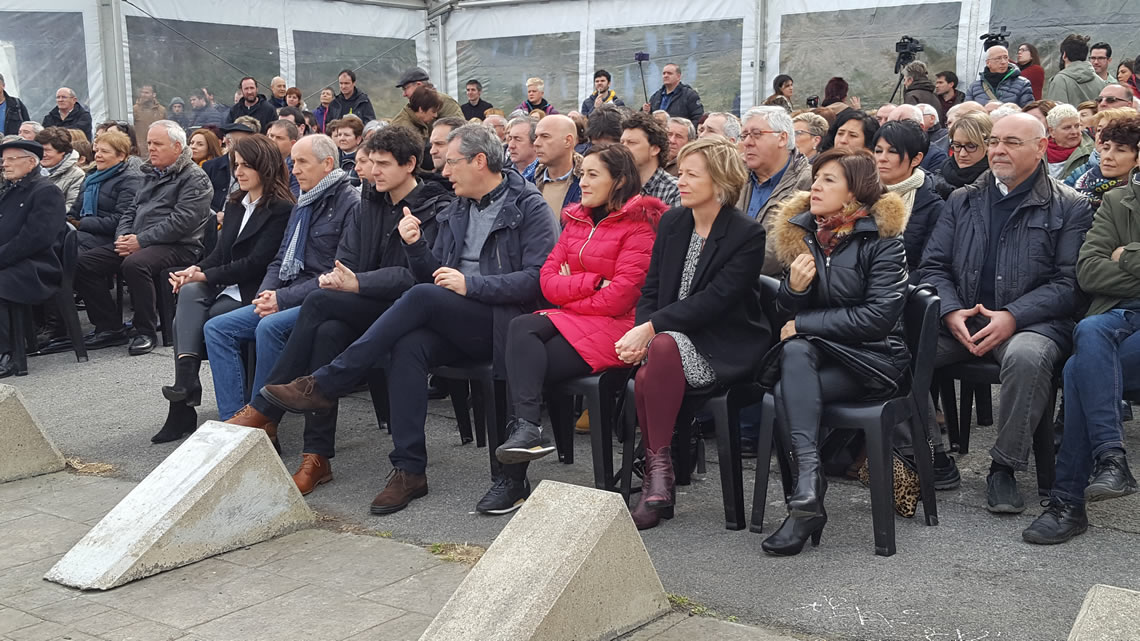


The Basque Government, Bermeo Local Council and the Matxitxako today celebrated the Itxas Gudari Eguna with a joint ceremony to remember and pay tribute to those people who lost their lives at the epic Battle of Matxitxako, the largest naval conflict of the Spanish Civil War, which took place in the Bay of Biscay 80 years ago.
The tribute was again held by the "Matxitxakoko Guda", Nestor Basterretxea's sculpture, off the road between Bermeo and Bakio. During the ceremony, wreaths were laid in their memory, there was a performance by "Kukai", the Basque contemporary dance group, and "Boga, boga, Mariñela" was sung. A representative of each organisation - the Basque Government's Spokesperson and Minister for Public Governance and Self-Government, Josu Erkoreka, the Mayor of Bermeo, Idurre Bideguren, and the Chair of the Matxitxako Assocation, Javier Olabeaga - also spoke.
WOMEN OF THE EUSKO ITSAS GUDAROSTEA
In the run-up to International Women's Day, on 8 March, Josu Erkoreka, took the opportunity to specifically pay tribute to all the women who took part in the Civil War and, specifically, to the three that the Basque Government know where in the Auxiliary Navy of the Basque Country (Euzko Itsas Gudarostea): Paquita García, María Luisa Jiménez Alzaga and Miren Lenizbarrutia.
Josu Erkoreka stressed that it was only fair to also pay tribute to those women about whom we know very little, but who fought with great bravery, alongside the men, to defend their ideals and the human rights that were being trampled by Franco's army. Their work was much less low-profile than that of their comrades in arms, and unfairly kept under wraps by society at that time.
BATTLE OF MATXITXAKO
The Battle of Matxitxako was the most important naval conflict in the Bay of Biscay of the Spanish Civil War. The Basque Government's navy was locked in combat with Franco's naval forces on 5 March 1937.
The merchant vessel Galdames was sailing from Bayonne, to Bilbao, escorted by 4 small armed fishing boats of the Auxiliary Navy of the Basque Country (Euzko Itsas Gudarostea): the Bizkaya, the Gipuzkoa, the Donostia and the Nabarra. In the early hours of 5 March, the Gipuzkoa and the Bizkaya lost contact with the rest of the convoy due to the prevailing bad weather. As they were trying to make it back to the convoy, they came across the most powerful vessel of Franco's navy, the cruiser Canarias. This led to the first of the two closely fought clashes when five crew members of the Gipuzkoa died. The two vessels managed to make their way to the harbours of Portugalete and Bermeo, respectively, even though they were seriously damaged.
Meanwhile, the merchant vessel Galdames, in which 173 passengers were travelling, continued on its way but only escorted by the Nabarra and the Donostia. When they reached Cape Matxitxako, they were surprised by the Canarias, which led to the second closely-fought encounter of the day and which lasted for over an hour and a half.
The Canarias was much larger, more powerful and better armed. It first attacked the Galdames, killing a woman and three children. The vessel surrendered and was seized. The Canarias then attacked the Donostia, but nobody was killed and there was no damage to the boat. Finally, the Canarias opened fire and hit the boilers of the Nabarra and it sank.
Twenty-seven combatants on the Nabarra died during the naval battle. A further 20 of its crew made it to the life boats and were taken prisoner by Franco's forces. However, Commander Enrique Moreno and First Officer Ambrosio Sarasola decided to remain on board the Nabarra and go down with the fishing boat rather than be taken prisoner.
The 20 survivors of the Nabarra appeared before a military court and weresentenced to death "for aiding the rebellion". However, the commander and gunnery officer of the Canarias directly interceded on their behalf and those 20 sailors were pardoned in recognition of their bravery in the tough fight.
Several months later, the 20 were freed on 30 November 1938.
10 YEARS OF "MATXITXAKOKO GUDA"
The tribute took place next to Nestor Basterretxea's "Matxitxakoko Guda" sculpture, which depicts the half-sunken Nabarra. It was installed looking out to sea 10 years ago to mark the 70th anniversary of this naval battle.