

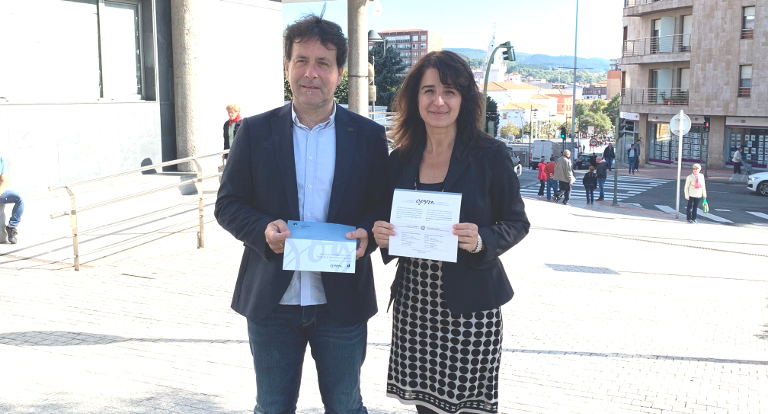
The Mayor of Basauri, Asier Iragorri, and the Director of the Institute for Remembrance, Coexistence and Human Rights – Gogora, Aintzane Ezenarro, have unveiled the Remembrance Square initiative.
During the presentation, the Mayor stressed that the exhibition is “a great opportunity for the people of Basauri to recover and disseminate our local history and also to contribute our collective, family and personal experiences to the joint memory of the whole Basque people”.
Aintzane Ezenarro outlined the Remembrance Square exhibition, a citizen participation project that began in 2016 and which has so far been held at different 23 locations and has visited the Basque Country’s main municipalities, including the three Basque capitals and the campuses of the three Basque universities. The exhibition is based on the witness accounts of the victims of terrorism and violence to foster a critical reflection of the past in order to construct a shared and pluralistic memory.
The exhibition will be open to the public from 24 to 30 October in a marquee set up in the town’s Plaza San Fausto square. On the day the exhibition opens to the public, at 6.00 p.m. on 24 October, the venue will host a dialogue session with victims of terrorism and violence, in which Ezenarro encouraged the local residents of Basauri to take part. A documentary on the history of the pacificism movements in the Basque Country will be screened for the first time.
The activity in the exhibition area will begin that same morning. Students from the 4th year of compulsory secondary education, upper secondary and vocational training will take part in educational workshops to learn about the necessary aspects to construct memory and perform a critical reflection. Around ten workshops, involving around 200 students, will be run on weekdays while the exhibition is in Basauri.
Since the first time the exhibition was held – in Bilbao in February 2016 -, 37,600 people have taken part in the 23 editions of the exhibition and the activities organised for it. 5,250 of that number were students from the 4th year of compulsory secondary education, upper secondary and vocational training, who have taken part in workshops specifically designed for that audience.
OBJECTIVES
- To disseminate and share the memory through an exhibition and be the driving force for reflection constructed among all of us.
- To provide a space where the general public can leave their accounts.
- To work on remembrance at municipal level by driving dynamics in order to share critical reflections on the past.
- Outreach and to showcase the Gogora Institute to the general public.
EXHIBITION VENUE
The exhibition will be set up in a marquee with different areas:
- Account recording area: Visitors to the exhibition can record or write in situ their witness accounts.
- Witness account videos: Visitors can listen to the accounts of victims of Franco’s dictatorship, terrorism and the victims coming under Decree 107/2012.
- Documentary screening and discussion area.
- Message mural: Visitors to the exhibition can leave a written message on a mural and also in an urn, to be kept at the Gogora Institute and to be published on the Remembrance Square website.
REMEMBRANCE SQUARE BACKGROUND
The Remembrance Square exhibition has so far visited Bilbao, Durango, Tolosa, Vitoria-Gasteiz, Eibar, Donostia/San Sebastián, Zarautz, Arrasate, Getxo, Lasarte-Oria, Gernika, Santurtzi, Portugalete, Sestao, Barakaldo, Irun, Beasain, Galdakao and Llodio.
The exhibition has also been held at the Arrasate-Mondragón campus of Mondragón University, the Bilbao campus of Deusto University and the Donostia-San Sebastián campus of the UPV-EHU (University of the Basque Country).
See other experiences: https://goo.gl/DR8Y4i